

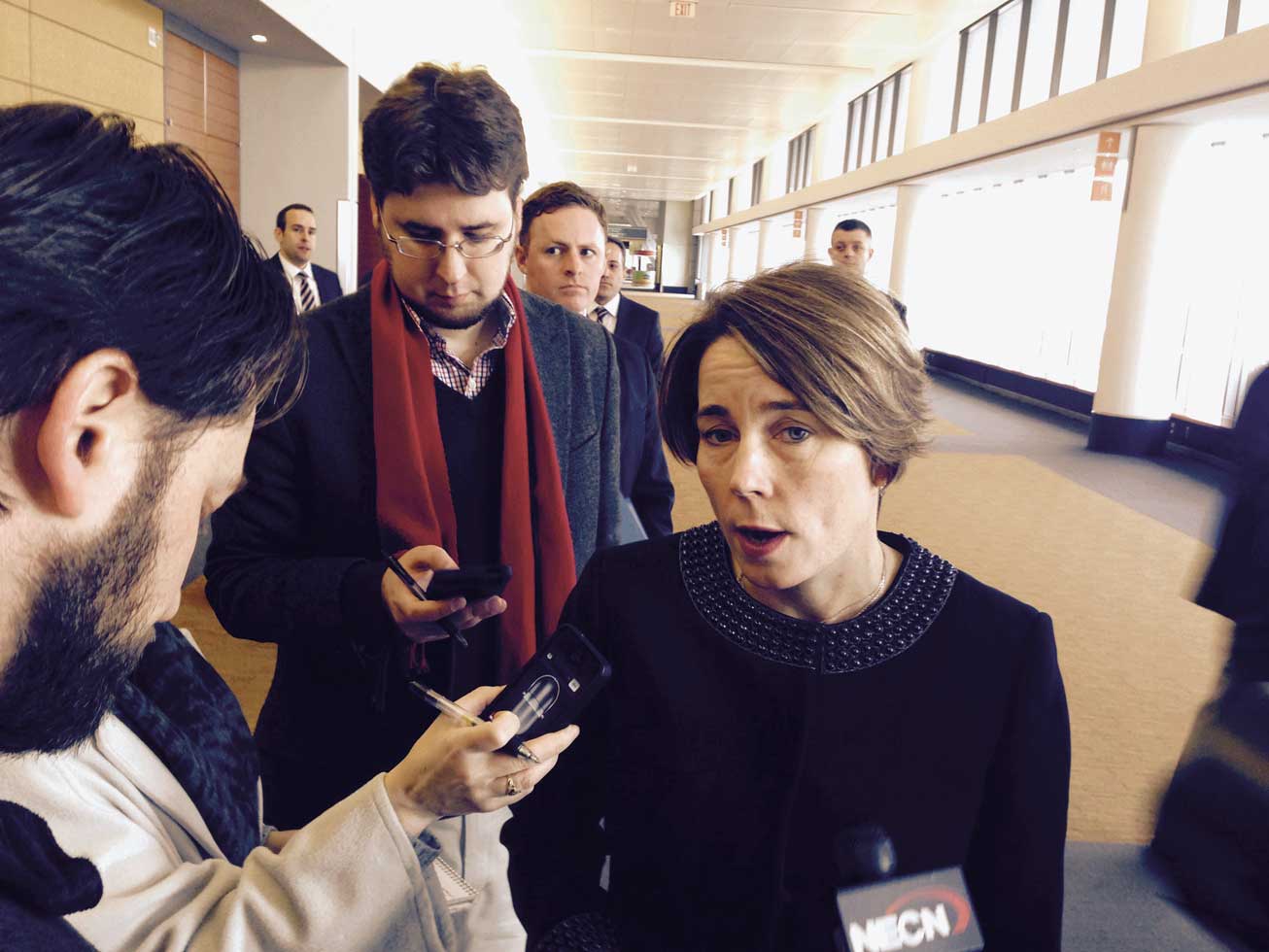
ATTORNEY GENERAL MAURA HEALEY’S OFFICE said the Massachusetts Gaming Commission violated the state’s Open Meeting Law on several occasions by holding private meetings where operation and management of the agency was discussed.
A review by Healey’s office, prompted by several articles in the Boston Herald, credited the commission with “broad compliance” with the Open Meeting Law but said some violations occurred when the commissioners met during private lunches, at staff meetings, and at a meeting where four of the commissioners discussed how to avoid deadlocked votes in awarding the Greater Boston casino license.
Amy Nable, the assistant attorney general who conducted the review, said in a Dec. 23 letter to the commission that all of the violations involved discussions about managing the agency. “These conversations did not concern the evaluation and award of gaming licenses,” Nable wrote.
The results of Healey’s investigation were first reported by the Boston Herald last week. Nable’s letter to the commission was not released publicly by the Attorney General, but the Gaming Commission posted the document along with a statement about it on its website.
Nable described her office’s review as “less formal than litigation, with the ultimate goal of achieving compliance with the Open Meeting Law.”
The Open Meeting Law defines a meeting as “a deliberation by a public body with respect to any matter within the body’s jurisdiction.” Nable said in her letter that any discussions about the daily management of the commission fall within the agency’s jurisdiction and should be discussed in public. Nable said discussions about whether to hire a consultant, whether to authorize a report on the Greater Boston casino licensing process, and what to do if a referendum banning casino gambling passed should have been reserved for public meetings.
“Because these topics relate to the operation of the commission, they constitute matters within the jurisdiction of the commission and should have been discussed during a meeting,” Nable wrote. “By discussing them during a private lunch, the commissioners violated the Open Meeting Law.”
The commissioners also participated in agency staff meetings and in the early days of the commission those meetings consisted of the five commissioners and a handful of employees. During those meetings, Nable said, discussions about the agency’s management and operations were held in violation of the law. Nable said the staff meeting violations subsided after more workers were hired at the agency and the commissioners had less day-to-day work to do. “It appears that the staff meetings in their current form comply with the Open Meeting Law,” Nable wrote.
Another violation of the Open Meeting Law occurred on May 20, 2014, when at least three of the five commissioners held a private discussion on how to avoid stalemated votes after Stephen Crosby, the commission’s chairman, recused himself from all further deliberations on the Greater Boston casino licensing process. Nable’s letter said the commissioners “met briefly to discuss the need to research strategies for avoiding deadlock in awarding the license.” She said the researched strategies were later discussed in open meetings.
The attorney general’s office also reviewed a number of other private meetings of the commissioners that were held for social reasons, for training, or for information purposes. Each commissioner also met individually with Steve Wynn on Sept. 19, 2014, shortly after Wynn’s Las Vegas company was awarded the Greater Boston casino license. Wynn thanked the commissioners for awarding his firm the license and showed them the high-quality bed lines he planned to use at his proposed hotel, according to Nable’s letter.
Nable concluded she lacked evidence to suggest these meetings violated the law, but she reminded the commissioners of their duties under the statute and recommended they receive training by her office on how to comply. The Gaming Commission issued a statement on Dec. 24 saying it planned to schedule a training session with the attorney general’s office.
“In keeping with our obligations under the law, the commissioners are unable to discuss the contents of the AG’s letter among themselves, but will place this important topic on the agenda for the next public meeting allowing them to engage in a substantive discussion and determine next steps,” said Elaine Driscoll, a spokeswoman for the Gaming Commission.